

I’ve decided to tackle a contentious one today. RRSP’s vs Corporate investments.
This one get’s quite a bit of hate online I will say and often I get challenged by accountants as well. It’s also one that’s tough to compare apples to apples because most people don’t start at the beginning and “follow the flow of the money”.
For incorporated business owners - they start with excess profit in their corporation that they don’t need and therefore plan to invest as the first step. We can use $30,000 as the example here. From those profits there is a choice to make:
You could leave it in the corporation. If you do - you have to pay corporate tax and then invest the after tax profits. Small business deduction limit means profits up to the first $500,000 in Ontario are taxed at 12.2%. Based on $30,000 of profit - 12.2% of tax would be tax of $3,660. This leaves $26,340 left over to invest.
You could pay yourself salary or bonus. You then roll that money into your RRSP. If you do this - then the RRSP contribution functions as a deduction which wipes out the taxable income you got by taking money from the corporation. $30,000 leaves the corp as extra salary to you and then rolls into the RRSP which give you the $30,000 deduction. Net result is no additional tax and then $30,000 left to invest.
If we use Ontario as an example (I’m pulling a lot from this article from Jamie Golombek - https://www.jamiegolombek.com/pdf/RRSPs-for-business-owners-en.pdf) the next step is “what about investing it? What happens then?”
Interest income in an RRSP
I’m going to use interest income because it’s the most “punitive” and get’s the point across really quickly. If we used 5% interest income as the hypothetical - what happens is in the RRSP - the $30,000 grows by 5% to turn into $31,500. There is no tax paid because it’s all paid only when you pull the money out of the RRSP.
Interest Income in a Corporation
In the corporation - when the 5% interest income is earned - the corp will have to pay tax at tax time.
The tax on interest income in the corporation is taxed upfront at 50.17% and remember - we need to start with that “after corporate tax” amount of $26,340 to invest first.
$26,340 * 5% = $1,317
$1,500 * 50.17% tax = $660.74
After Tax proceeds = $1317-$660.74 + $26,340 = $26,996.26
Now - this is where it get’s weird. There is part of that $660.74 that is “refundable”. Specifically $403.92. When you pay dividends out of your corporation - the corp will get that refund of tax back which it can then pay out to you.
So in total then what we have to dividend out would be $26,996.26 + $403.92 = $27,400.18
Which is worth more after tax? $31,500 from an RRSP as fully taxable income of $27,400.18 as a non-eligible dividend?
Based on the top marginal tax rate of 53.53% for $31,500 from the RRSP - that would be $14,638.05.
The $27,400.18 when it comes out and the non-eligible dividend tax credit is applied - the final amount after tax is $14,319.33
$14,638.05 from the RRSP is better than $14,319.33 from the corporation.
RRSP wins.
What about other more tax efficient forms of income like eligible dividends and capital gains?
This is the crux of the question. The answer is that it depends. You are typically better off with Capital gains in the corporation (both deferred and realized) and eligible dividends are better up front but with a long enough compounding timeline (where you have to keep paying tax on the income either within the corp or when you dividend to yourself personally) - the fact that no tax is paid in the RRSP means it still starts to look pretty solid.
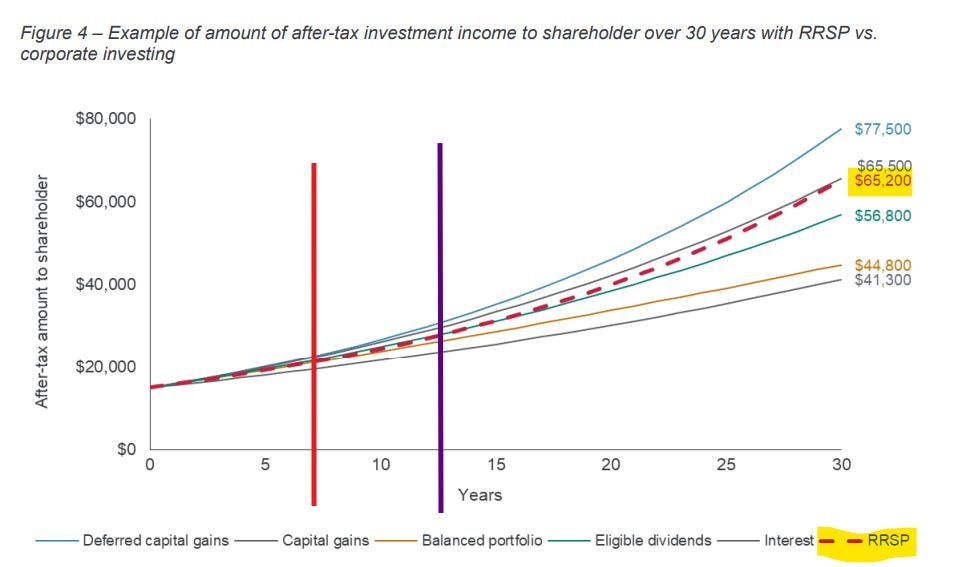
I won’t make you read out a bunch more math. Jamie Golombek did us all a favour and made this chart (Highlights and superimposed lines are mine). He ran the tax impact of various types of investment income that would generate a hypothetical 5% return and compared them to the RRSP.
To make it very simple:
the red line shows the point at which investing in an RRSP typically beats a diversified portfolio with a mix of stocks and bonds. About 6 to 10 years.
The purple line shows where investing in an RRSP typically beats even eligible dividends
Why do those graphs do that where the RRSP overtakes the eligible dividends “eventually”.
It’s due to what I call “frictional tax” or “tax drag”. While Eligible dividends are tax efficient - you still need to pay some tax on them. That means less money reinvested to grow. The RRSP on the other hand get’s the FULL compounding effect. No tax paid until withdrawal. So it starts out more tax efficient but the RRSP has a stronger compounding rate of return so it will catch up eventually.
This is where I have seen accountants and advisors even say “yes but look. The capital gains and eligible capital gains are better so I think that the corp is better. They aren’t wrong in a sense but we don’t really know which investments will do better and be solely capital gain based and keep in the corp vs sell things off. That note is even referenced here in the article:

So in general - the balanced portfolio is the most likely approach for comparison between the RRSP and TFSA. In that case - we see that the math clearly favours RRSP for long term wealth and retirement income.
So - if you are a business owner - don’t sleep on the RRSP. You’ll be costing yourself dearly.
Aravind Sithamparapillai is an Investment Advisor with Aligned Capital Partners Inc. (“ACPI”). The opinions expressed are those of the author and not necessarily those of ACPI. This material is provided for general information and the opinions expressed and information provided herein are subject to change without notice. Every effort has been made to compile this material from reliable sources however no warranty can be made as to its accuracy or completeness. Before acting on the information presented, please seek professional financial advice based on your personal circumstances. ACPI is a full-service investment dealer and a member of the Canadian Investor Protection Fund (“CIPF”) and the Canadian Investment Regulatory Organization (“CIRO”). Investment services are provided through ACPI or Ironwood Securities of Aligned Capital Partners Inc, an approved trade name of ACPI. Only investment-related products and services are offered through ACPI/ Ironwood Securities of Aligned Capital Partners Inc. and covered by the CIPF. Financial planning and insurance services are provided through Ironwood Wealth Management Group. Ironwood Wealth Management Group is an independent company separate and distinct from ACPI/ Ironwood Securities of Aligned Capital Partners Inc.
Nice article! From the chart it looks like the deferred capital gains is the clear winner - Is it your summation its not possible or it is unrealistic to have a portfolio that is set up to purely grow with deferred capital gains?
What about Swap ETFS? Is there another investment vehicle that can achieve this?